A pop-up says your computer is hacked. A “fraud investigator” calls back. Within days you’re told your savings are in danger and the only safe move is to turn them into gold bars and hand them to a federal agent who will come to collect them.
This is the gold bar scam, and in 2026 it is stripping retirement accounts across the country, one parking-lot handoff at a time.
The verdict: no bank, tech company or government agency will ever ask you to buy gold and give it to a courier. If anyone does, it is a scam. Every time.
In late September 2026, two couriers pleaded guilty in separate federal cases: one who collected $318,459 in gold from a 78-year-old Illinois woman, and one who flew to Hawaii to pick up gold from an 80-year-old grandmother. Here’s how the con works and how to stop it before the first bar is bought.
Why this scam works so well
This isn’t a sloppy text with typos. It’s a scripted operation that can run for weeks.
- It starts with a real-looking problem. A computer pop-up, a “fraud alert,” or a message saying your phone or bank account was hacked.
- It uses names you trust. Microsoft, Apple, your bank or brokerage, the U.S. Treasury, the U.S. Marshals, the Federal Reserve.
- Gold feels safe. Scammers pitch it as “protecting” your money from hackers. It sounds like a sensible, old-fashioned precaution.
- Secrecy cuts you off from help. Victims are told the case is confidential. In one Illinois case, the victim even signed a fake non-disclosure agreement.
- Fear does the rest. As one gold dealer told Capitol News Illinois, “People will do anything the minute they feel fear.”
How the gold bar scam works, step by step
- The hook. A pop-up, email or text warns that your computer, phone or account has been compromised. It gives a number to call. Sometimes victims find a fake “support” number through a web search.
- Remote access. A “technician” asks you to install software so they can “check” your device. Now they can see your bank and investment accounts, and they know exactly how much you have.
- The handoff to “fraud” or “government.” You’re transferred to someone claiming to be from your bank’s fraud team, the Treasury, or a federal agency. They say your accounts are being targeted, or even used for crimes.
- The “protection” plan. You’re told to pull money out of savings, an IRA or a brokerage account and buy gold bars or coins from a real dealer.
- Control and secrecy. You must check in daily, keep the phone line open, and tell no one, not your family, not your bank teller.
- The pickup. A courier meets you at your home or a public place, says a code word, and takes the gold “for safekeeping.” Then the gold, and the “agents,” disappear.
Most of these schemes begin with something you can paste and check. If you got a pop-up text, an email or a message warning that your account is hacked, paste it into the free ScamRead checker before you call any number in it.
ScamRead Scam Checker
Got a “your account is hacked” alert?
Before you call any number or install anything, paste the text, email or WhatsApp message into ScamRead. It’s free and takes seconds.
Check the message free →Real case: a $318,459 gold handoff in a Walmart parking lot
According to Capitol News Illinois, a 78-year-old woman in Marion, Illinois, saw a pop-up in April 2026 warning that her computer was compromised. She called a number she believed was Microsoft support. A man calling himself “Mike Williams” got remote access to her computer and passed her to “Kevin Jones,” who claimed to work in fraud prevention for her brokerage, Edward Jones.
Over the next weeks, she signed a “non-disclosure agreement,” was given a “tracker phone,” and had to text “good morning” and “good night” every day. She moved $1.8 million out of her investment accounts. On June 8, she met a courier in a Walmart parking lot, gave the code word “black bug,” and handed over $318,459 in gold bars.
When the scammers came back for a second load of roughly $272,000, law enforcement set up a sting. On July 7, Ruoyu Lian, 30, of Flushing, New York, was arrested at the pickup. He pleaded guilty on September 24, 2026, to wire fraud and conspiracy to commit wire fraud. Sentencing is set for January 2027.
A second case followed a day later. As Hoodline reported, an 80-year-old woman in Kaneohe, Hawaii, got a fake Apple support message saying her phone was hacked. A caller posing as a U.S. Marshal convinced her to drain her IRA and buy gold. A 25-year-old courier flew to Hawaii and collected $137,458 in gold, using a one-dollar bill as the “password.” He pleaded guilty on September 25, 2026.
These aren’t isolated. In March 2026, federal prosecutors in St. Louis charged three people in a conspiracy that stole $8 million from elderly victims in at least seven states. One victim was told to buy $200,000 in gold over a false PayPal problem. The FBI has counted more than 1,700 of these scams between 2023 and May 2025, with about $186 million in losses.
New variants to watch for
- The fake U.S. Marshal. Instead of “tech support,” the caller claims to be a marshal or federal agent protecting your identity.
- The fake Apple or PayPal alert. A text or email about a hacked account or an unauthorized charge is the opening move.
- Cash instead of gold. Some victims are told to hand over cash, or mail it in a box.
- The “Federal Reserve vault.” Couriers claim the gold is being stored at a Federal Reserve or Treasury facility. No such program exists for the public.
If you’re getting messages like these, our guide to the FBI scam call explains how fake agents spoof real phone numbers, and our breakdown of the scary virus warning pop-up shows how the first step in many gold bar scams works.
The scammer’s toolkit
| Tool | What it does | Why it works |
|---|---|---|
| Fake security pop-up or alert | Claims your computer, phone or account is hacked | Creates instant panic and gives you a number to call |
| Remote-access software | Lets the “technician” see your screen and accounts | They learn exactly how much money you have |
| Fake bank or agency “transfer” | Passes you to a “fraud investigator” or “agent” | A second voice makes the story feel confirmed |
| Non-disclosure agreement | Orders you to keep everything secret | Blocks family and bank staff from warning you |
| “Tracker phone” or daily check-ins | Keeps you under constant contact | You never get time alone to think or ask for help |
| Code word for the courier | “Authenticates” the person at the pickup | Feels like official security procedure |
| Hired courier | Picks up the gold in person | Gold moves fast and is hard to trace once handed over |
Red flags: how to spot it
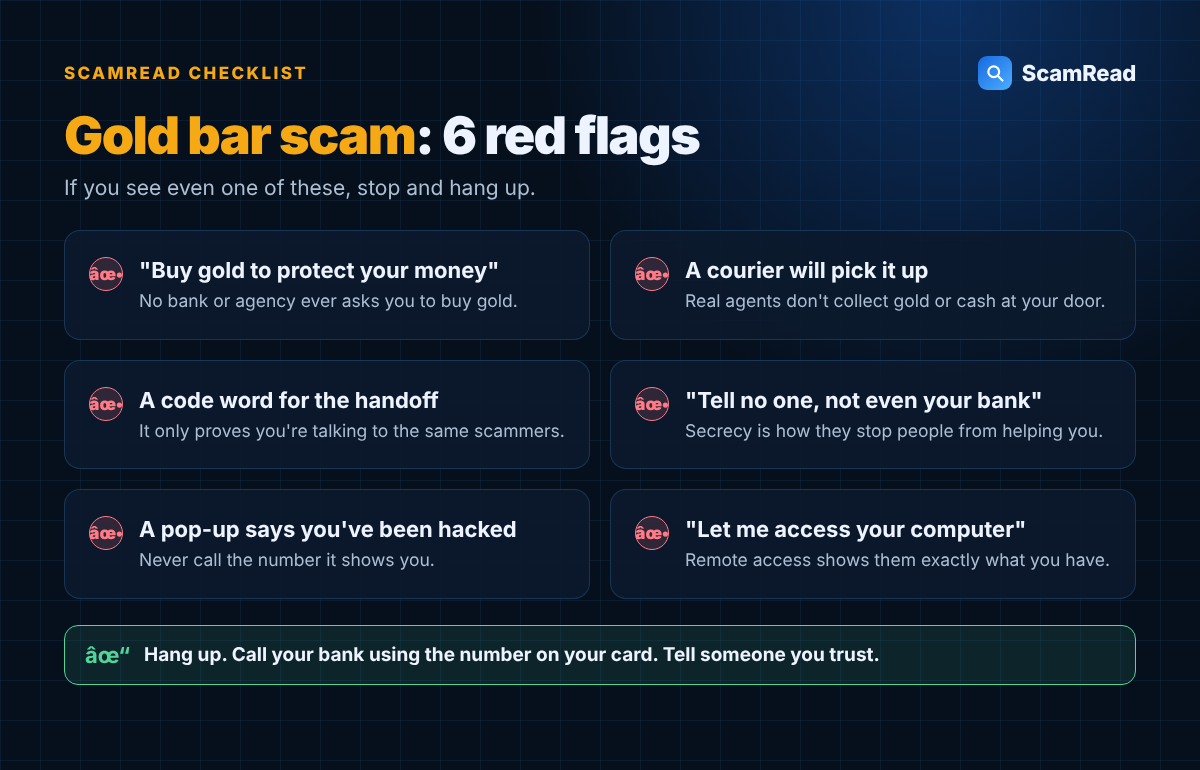
- Anyone tells you to buy gold, silver or other precious metals to “protect” your money.
- A government agent or bank employee wants to pick up money or valuables in person.
- You’re given a code word or password for a handoff.
- You’re told not to tell family, your bank or police.
- A pop-up or message gives you a phone number to call about a hack.
- Someone asks to install software on your computer or phone.
- You’re told to lie to your bank about why you’re withdrawing money.
The FBI puts it plainly: “The US Government and legitimate businesses will never request you purchase gold or other precious metals.”
How to check if it’s real
- Stop and hang up. A real investigation can wait 10 minutes. Scammers can’t.
- Call your bank yourself. Use the number on the back of your card or on your statement, never a number from a pop-up, text or caller.
- Look up agencies independently. Find the real phone number on the agency’s official .gov website.
- Tell someone you trust. If the “agent” says you can’t, that alone tells you it’s a scam.
- Check the message. Paste the alert, email, text or WhatsApp message into ScamRead’s free scam checker. It reads the wording, links and sender details for common scam patterns. (It can’t listen to phone calls, but it can check what was sent to you in writing.)
ScamRead Scam Checker
Someone told you to buy gold?
Paste the email, text or message they sent you into ScamRead and see the warning signs before you move a single dollar.
Check it now →Already paid or shared info? Do this now
- Stop all contact. Don’t answer the “tracker phone” or any calls from the “agents.” Don’t hand over any more gold or cash.
- Call your bank and brokerage now. Tell them you were scammed. Ask them to lock accounts, stop pending transfers, and change your login details.
- Call your local police. If a second pickup is planned, police may be able to set up a sting, as they did in Illinois.
- Clean your devices. If you allowed remote access, uninstall the software and have your computer checked by a trusted technician. Change your passwords from a different, clean device.
- Freeze your credit if you shared your Social Security number with Equifax, Experian and TransUnion. It’s free.
- Report identity theft at IdentityTheft.gov for a recovery plan.
- Report the scam to the FBI at ic3.gov and to the FTC at ReportFraud.ftc.gov. If you’re 60 or older, the DOJ Elder Justice Hotline is 1-833-FRAUD-11 (1-833-372-8311).
How the couriers get caught
The callers are often overseas. The couriers have to show up in person, and that’s their weak point.
- Stings at the second pickup. When victims or families report early, police can be waiting at the next handoff. That’s how the Illinois courier was arrested.
- The travel trail. Couriers fly, rent cars and book hotels, and those records can be followed.
- The money trail. Gold has to be sold or moved somewhere. Dealer records, bank deposits and shipping records leave evidence.
- Reporting links the cases. Every report to IC3 helps the FBI connect one courier to many victims. That’s how one St. Louis case grew to $8 million across seven states.
Couriers face up to 20 years in federal prison for wire fraud. But stopping the handoff is the only way to keep the gold. Once it’s gone, it’s rarely recovered.
FAQ
Is the gold bar scam real?
Yes. The FBI has counted more than 1,700 cases between 2023 and May 2025. Scammers posing as tech support, banks or government agents convince victims to buy gold and hand it to a courier.
Would the government ever ask me to buy gold?
No. The FBI says the U.S. government and legitimate businesses will never ask you to buy gold or other precious metals. No agency collects gold from the public for “safekeeping.”
Can a U.S. Marshal or Treasury agent pick up my money?
No. Federal agents don’t collect cash, gold or valuables at your home or in a parking lot to protect your accounts. Anyone who offers to is a scammer.
What should I do if a pop-up says my computer is hacked?
Don’t call the number on it. Close the browser (or restart the computer), and never let a caller install remote-access software. If you’re unsure, paste the message text into a scam checker or ask someone you trust.
Can I get my gold back after being scammed?
It’s difficult. Recovery happens mostly when couriers are caught and ordered to pay restitution. Report quickly to police, your bank and ic3.gov to give investigators the best chance.
The bottom line
The gold bar scam works because it feels like protection. But the rule is simple: nobody legitimate will ever ask you to buy gold and hand it to a stranger. Not your bank, not Microsoft or Apple, not the Treasury, not a U.S. Marshal.
If an alert, email or text is pushing you toward that path, stop. Talk to someone you trust. And before you call any number in a suspicious message, check it free with ScamRead. Share this with a parent or grandparent. It might save their retirement.
Sources
- Capitol News Illinois: Marion woman duped out of $318K in elaborate gold-bar scheme (Sept. 30, 2026)
- Hoodline: Courier admits role in $137K gold scam targeting Kaneohe grandmother (Oct. 2026)
- U.S. Attorney’s Office, Eastern District of Missouri: Three accused of defrauding the elderly via gold bar scam
- FBI IC3 Public Service Announcement: Scammers using couriers to retrieve cash and precious metals