The phone rings for the fourth time today. A friendly voice says they’re “with Medicare.” Your new Medicare card is on its way, they just need you to confirm your Medicare number. Oh, and you qualify for a free back brace.
That is one of the most common Medicare scam calls in America right now, and it gets louder every fall. Medicare Open Enrollment runs October 15 to December 7, and scammers plan their year around it.
The verdict: if someone calls you out of the blue and asks for your Medicare number, offers “free” medical equipment, or says your benefits will stop, it’s a scam. Hang up. Medicare.gov says Medicare “will never call you uninvited” to ask for personal or private information.
Below: how the con works, a real case where overseas call centers fed a $35 million fraud, the red flags, and exactly what to do if you already gave your number. And if the call was followed by a text or email “from Medicare,” you can paste it into the free ScamRead checker before you click anything.
Why Medicare scam calls work so well
These callers aren’t guessing. They often already know your name, age and address, sometimes more. That makes the call feel official from the first sentence.
- The timing is perfect. During Open Enrollment you expect to hear about plans, so a call about Medicare doesn’t seem strange.
- “Free” is hard to refuse. A no-cost brace, test kit or glucose monitor sounds like a benefit you’ve earned.
- The “new card” story sounds routine. Medicare did replace cards years ago, so the line still lands. An AARP Rhode Island volunteer told NBC 10 in September that there are no new Medicare cards, and that the claim is a ploy.
- They wear you down. Many people get call after call. Eventually someone picks up and says “yes” just to make it stop.
How Medicare scam calls work, step by step
- The cold call. A caller says they’re from Medicare, “your health plan” or a “benefits department.” Caller ID may show a local-looking number.
- The hook. A new card, a better plan, a refund, or free medical equipment “at no cost to you.”
- The ask. “Just confirm your Medicare number.” Sometimes your Social Security number, bank details or doctor’s name too.
- The rubber stamp. A “doctor” or “nurse” may come on the line briefly. In real cases, prosecutors say doctors signed orders based on call recordings, often without ever speaking to the patient.
- The billing. Your Medicare number is used to bill Medicare or your Medicare Advantage plan for braces, tests or services you didn’t need. A box may show up at your door. The money goes to the scammers.
- The fallout. Fake claims can end up in your medical record. Your number gets shared with other scammers, and the calls multiply.
The CMS security team described a real call like this: a caller told an older woman a new card was coming, asked her to confirm her Medicare number and address, then pitched a back brace. When she hung up, the caller called back, and her scam calls increased afterward.
ScamRead Scam Checker
Got a “Medicare” text or email after the call?
Scammers often follow a call with a message or link to “finish your enrollment.” Paste the text, email or link into ScamRead and get a plain-English verdict in seconds. Free, no sign-up.
Real case: overseas call centers, “free” braces, $35 million in claims
This isn’t a theory. In December 2025, a federal jury in Miami convicted two South Florida men, healthcare executive Michael Kochen and telemarketing company owner Sandro Herek, in a Medicare Advantage brace scheme.
According to the U.S. Attorney’s Office for the Southern District of Florida:
- Herek directed overseas call centers, including in Egypt, that cold-called Medicare beneficiaries who hadn’t asked for anything.
- Callers often kept calling after people said no, and used high-pressure tactics.
- Scripts falsely promised the braces would come at no cost.
- Doctors often signed off based on call recordings, and in many cases never spoke with the patient.
The U.S. Attorney said the defendants “exploited trust and age, using pressure tactics and fake medical justifications.” In July 2026 the two were sentenced to federal prison over roughly $35 million in false claims. The Senior Medicare Patrol reports Kochen received 17 years and Herek more than seven.
And it keeps happening. On September 4, 2026, two more Florida men were sentenced in a separate $34.8 million brace scheme. Prosecutors said braces were shipped nationwide to Medicare beneficiaries who neither requested nor needed them.
New variants to watch this Open Enrollment
- Fake search ads. The FTC warned on September 28, 2026 that “scammers and dishonest businesses sometimes pay to appear at the top” of search results, with look-alike sites and logos imitating Medicare.gov. We’ve covered how fake websites fool careful people. If you’re unsure about a link, run it through ScamRead first.
- “Free gift” offers. Genetic tests, glucose monitors and medical kits, by phone, mail, email or text.
- AI-polished calls. CMS warns that AI helps scammers write natural scripts, drop accents and tailor pitches to your age or health.
- Plan “representatives.” Unsolicited calls, texts and emails promising “the best programs” if you just share your details.
The scammer’s toolkit
| Tool | What it does | Why it works |
|---|---|---|
| Leaked personal data | Gives the caller your name, age, address | Makes them sound like they’re reading your file |
| Local-looking caller ID | Hides an overseas call center | People answer numbers that look nearby |
| “New card” or “free brace” script | Gives a harmless-sounding reason to “confirm” your number | Feels like routine paperwork or a perk |
| Telemedicine “doctors” | Sign orders without a real exam | Creates paperwork to bill Medicare |
| Repeat calls | Keeps calling after you say no | Wears people down until they agree |
| Paid search ads and look-alike sites | Put fake “Medicare” pages above real results | People trust the top result |
7 red flags of a Medicare scam call
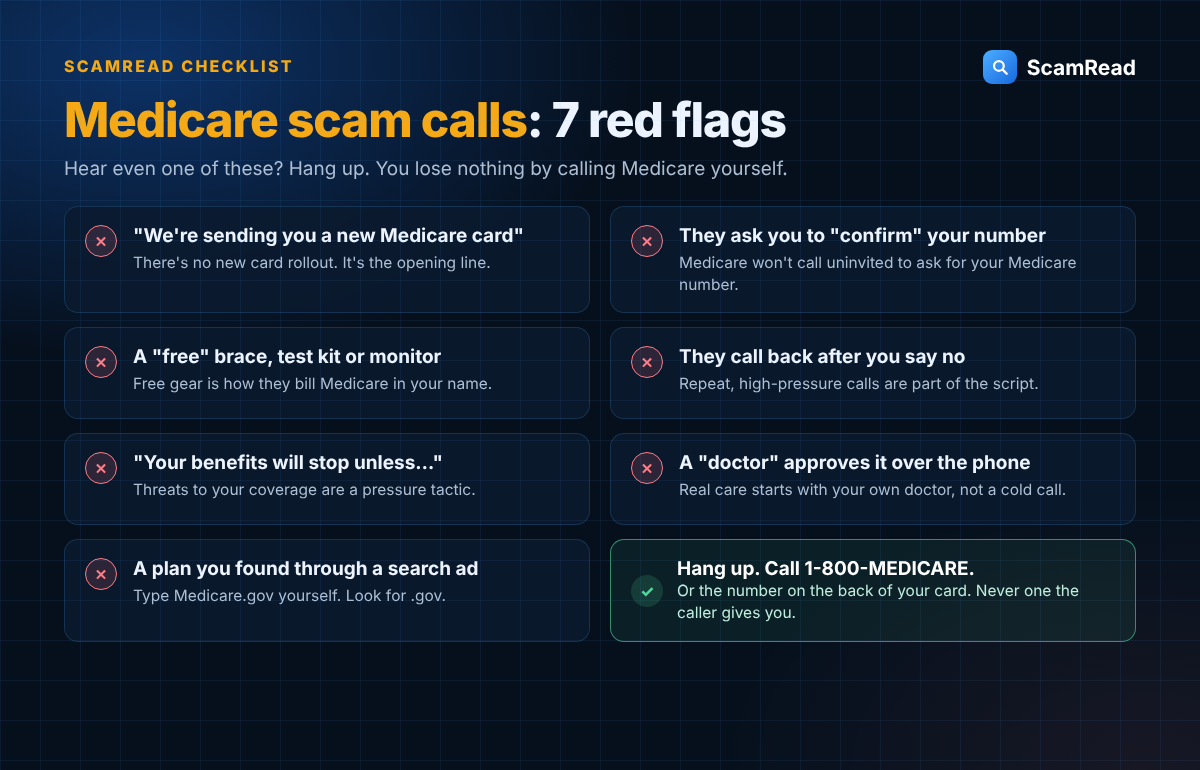
- “We’re sending you a new Medicare card.”
- They ask you to “confirm” or “verify” your Medicare number.
- They offer a “free” brace, test kit, monitor or gift.
- They call back after you’ve said no.
- They threaten that your benefits or coverage will stop.
- A “doctor” approves equipment over the phone, without your own doctor involved.
- You found the “Medicare” site or phone number through an ad.
How to check if a Medicare call is real
Use the CMS rule: “Trust no one who contacts you first.”
- Hang up and call back yourself. Use 1-800-MEDICARE (1-800-633-4227) or the number on your plan card. Never a number the caller gives you.
- Go to the source. Type Medicare.gov into your browser. Check that the address ends in .gov.
- Get free, unbiased help. Your State Health Insurance Assistance Program (SHIP) can compare plans with you at no cost.
- Check written messages. ScamRead can’t listen to phone calls, but most scams leave a trail. Paste the follow-up text, email or link and see what it really is.
Similar playbooks show up in other government impersonation calls. See our guide to the FBI scam call.
ScamRead Scam Checker
Not sure about a Medicare plan offer?
Before you reply, click or “enroll,” paste the email, text, WhatsApp message or link into ScamRead. We’ll flag the warning signs so you don’t have to guess.
Already gave your Medicare number or paid? Do this now
- Call Medicare. 1-800-MEDICARE (1-800-633-4227). Tell them your number may be compromised and ask what to do next.
- Watch your statements. Review your Medicare Summary Notices or plan statements, or log in at Medicare.gov, for services or equipment you never got. Don’t accept or sign for boxes you didn’t order.
- Call the Senior Medicare Patrol. 1-877-808-2468. They help people spot and report Medicare fraud for free.
- If you paid, call your bank, card issuer or payment app right away and ask to stop or reverse the payment.
- If you shared your Social Security number, freeze your credit with Equifax, Experian and TransUnion (it’s free), and make a recovery plan at IdentityTheft.gov.
- Report it. File at ReportFraud.ftc.gov and the FBI’s ic3.gov. You can also report Medicare fraud to the HHS Inspector General at 1-800-HHS-TIPS.
How Medicare scammers get caught
Medicare fraud leaves a paper trail that ordinary scams don’t. Every fake claim has a billing company, a doctor’s signature and a bank account at the end of it. In the Kochen case, investigators traced kickbacks from equipment companies to telemarketers and telemedicine firms. In the September case, prosecutors said the defendants shifted billing between companies to dodge Medicare payment suspensions. That didn’t save them.
Your report matters. Unusual claims flagged by patients, plan fraud units and the Senior Medicare Patrol help investigators connect a single suspicious brace to a $35 million operation.
FAQ
Does Medicare call you on the phone?
Medicare says it will never call you uninvited to ask for personal or private information. It may call if you asked it to. If you’re not sure, hang up and call 1-800-MEDICARE yourself.
How do I stop Medicare scam calls?
Let unknown numbers go to voicemail, register at DoNotCall.gov, turn on your carrier’s spam blocking, and don’t press buttons or say “yes” on robocalls. Report the numbers at ReportFraud.ftc.gov.
Is there a new Medicare card in 2026?
AARP Rhode Island says there are no new Medicare cards, and that “new card” calls are a ploy. If you lost your card, request a replacement through your Medicare.gov account or 1-800-MEDICARE.
What happens if I gave my Medicare number to a scammer?
It can be used to bill Medicare for things you never got, which can affect your records and benefits. Call 1-800-MEDICARE, check your statements, and contact the Senior Medicare Patrol.
Are Medicare open enrollment scams only by phone?
No. They also come by text, email, mail and fake search ads. For anything written, you can paste it into the free ScamRead checker linked above.
The bottom line
Medicare scam calls work because they sound helpful. A new card. A free brace. A better plan. But the real Medicare won’t cold-call you for your number. Hang up, call the number on your card, and pick your plan through Medicare.gov or your local SHIP. Share this with a parent or neighbor before October 15. It’s the one call that matters.
Sources
- U.S. Attorney’s Office, S.D. Florida, “Two Healthcare Executives Convicted for Exploiting Elderly Medicare Advantage Beneficiaries” (Jan. 7, 2026): justice.gov
- HHS-OIG, sentencing of healthcare executive and telemarketing company owner (July 30, 2026): oig.hhs.gov
- Senior Medicare Patrol, “Update: Executives Sentenced for Exploiting Seniors” (July 29, 2026): smpresource.org
- U.S. Department of Justice, “Florida Men Sentenced to Prison for $34.8M Health Care Fraud Scheme” (Sept. 4, 2026): justice.gov
- FTC, “What to know ahead of Open Enrollment to avoid health insurance scams” (Sept. 28, 2026): consumer.ftc.gov
- CMS, “Why AI is making Medicare vishing scams more dangerous” (Feb. 11, 2026): security.cms.gov
- Medicare.gov, “Your Medicare card”: medicare.gov
- NBC 10 / WJAR, “AARP Rhode Island warns of Medicare scams ahead of open enrollment” (Sept. 15, 2026): turnto10.com
- FTC: ReportFraud.ftc.gov · IdentityTheft.gov · FBI IC3: ic3.gov