You have reported the fraud. Now you are waiting, checking your phone and wondering if anyone is actually doing something. Here is what happens behind the scenes, in plain words.
In short
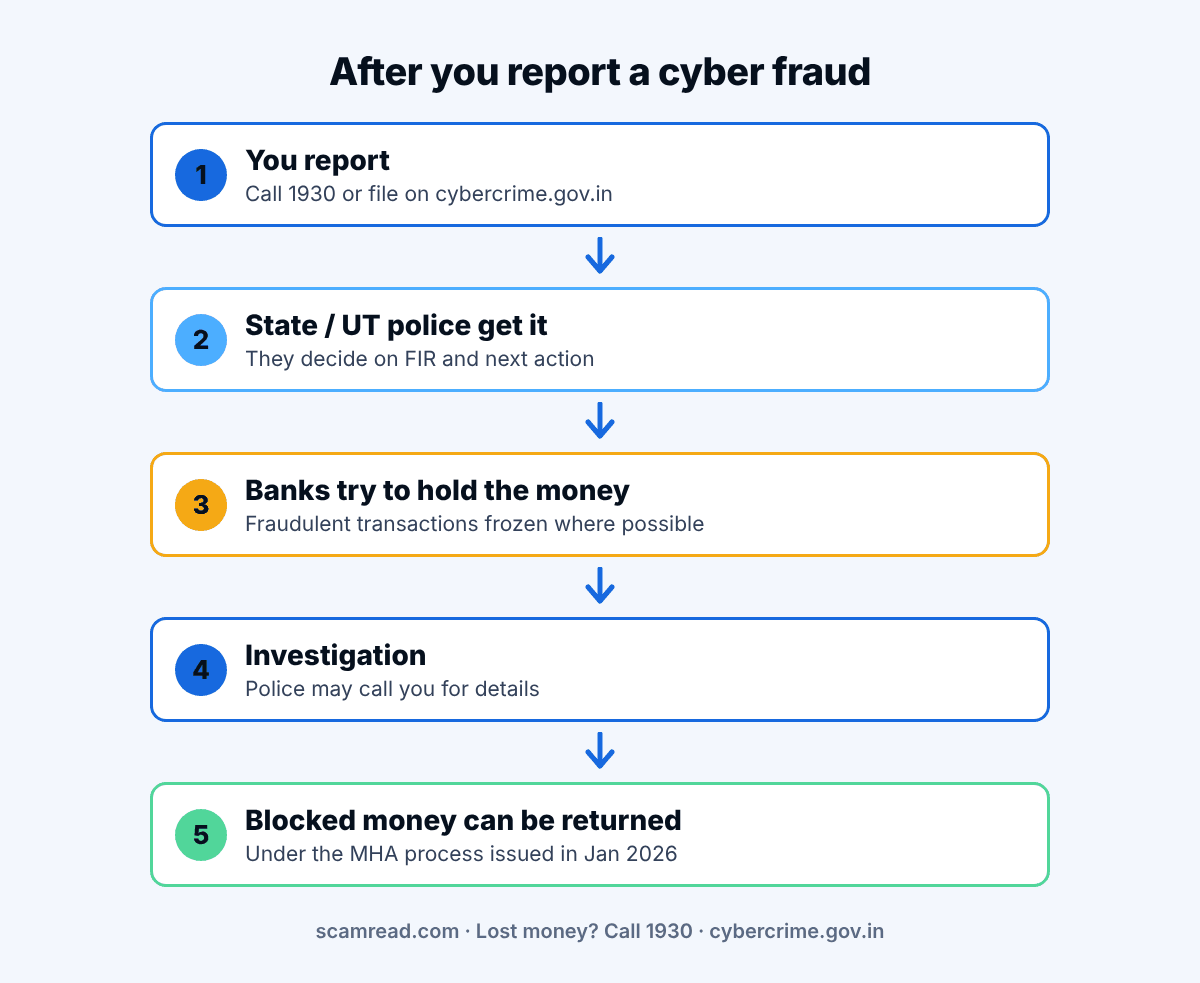
- Your complaint is handled by the police of your state or Union Territory. They decide on an FIR and the next action.
- For money frauds, a central system links police and banks to try to stop the money moving.
- Money blocked in the banking system can be returned to victims under a government process.
- You can track your complaint on cybercrime.gov.in using your complaint reference number.
Getting calls or messages from people claiming they can “speed up” your complaint? Paste the message into the free ScamRead checker. It pulls out the links, numbers and other details in the message and lists any warning signs it spots. A low score does not prove a message is safe, so trust the warning signs in this post too.
Check a messageIn this post
Step 1: Your report is logged
There are two official ways in. The 1930 helpline helps you lodge a cyber complaint, and the National Cyber Crime Reporting Portal (cybercrime.gov.in) lets you file online and upload proof such as screenshots and transaction IDs.
The government says it is important to give correct and accurate details for quick action. Double-check your bank account, UPI transaction ID, date and amount.
Step 2: It goes to your state police
The Ministry of Home Affairs says complaints on the portal, their conversion into FIRs and further action are handled by the State/UT police concerned, as per the law. So the case is with your local cyber police, not a central office in Delhi.
Step 3: Banks try to hold the money
For money frauds, the Citizen Financial Cyber Fraud Reporting and Management System (CFCFRMS) is meant for quick reporting and to stop fraudsters from moving the money away. It helps victims report quickly so that, where possible, the fraudulent transactions can be frozen.
The government reports that more than ₹11,158 crore had been saved in more than 32.80 lakh complaints through this system till 30 June 2026. That is why reporting fast matters.
Good to know: e-Zero FIR
In May 2025 the government started an e-Zero FIR system, first as a pilot in Delhi, for losses above ₹10 lakh reported on the portal or 1930. The complaint becomes a Zero FIR automatically, and the victim can visit the cybercrime police station within 3 days to turn it into a regular FIR. The government said it would be extended across the country.
Step 4: FIR and investigation
Your state police look at the complaint and decide whether to register an FIR and how to investigate. Keep your phone on. Police may call you to confirm details or ask for documents.
Step 5: Getting blocked money back
In January 2026 the Ministry of Home Affairs issued a standard process (SOP) so that money blocked in the banking system can be returned to victims as early as possible. The Supreme Court has directed all High Courts to ensure it is followed. The government says around one lakh citizens have benefited from this money restoration process so far.
Not every case ends with money back. It depends on how fast you reported and whether the money was still in the system.
How to follow up
- Keep your complaint reference (acknowledgement) number safe. The national portal says you can track status by entering this number.
- Save all proof in one folder: screenshots, bank SMS, statements.
- If calls to your state 1930 line go unanswered, the government has set up a national 1930 centre to pick up such calls.
Watch out
Be careful if someone calls saying they are from a “cyber cell” and can release your money for a fee. Don’t pay. Check by calling 1930 yourself.
What to do now
- Report as soon as you notice the fraud: call 1930 and file on cybercrime.gov.in.
- Write down your reference number and keep it handy.
- Tell your bank about the fraud too, and keep their reply.
- Respond quickly if police contact you.
- Do not pay anyone who promises to “recover” your money.
Report it
Lost money or shared bank details? Call 1930 (national cyber crime helpline) as soon as you can, and report at cybercrime.gov.in.
Related reads: Recovery scams that promise to get your money back · How to check if a website is a scam
Got a follow-up call or message about your complaint that feels off? Check it first. It pulls out the links, numbers and other details in the message and lists any warning signs it spots. A low score does not prove a message is safe, so trust the warning signs in this post too.
Open the free checkerThis is general information, not legal advice.