A relative, a WhatsApp group or a friendly agent wants you to put money into a scheme that pays a fixed monthly return – and you want to check it before you pay.
In short
- Sachet (sachet.rbi.org.in) is RBI’s public website for checking who may take deposits and for reporting illegal money collection.
- Individuals, partnership firms and informal groups generally cannot take deposits from the public.
- Very high returns and “bring new members” bonuses are classic signs of a Ponzi or pyramid scheme.
- Report suspicious schemes on Sachet. If you’ve already lost money, also call 1930 and go to the police.
Not sure about a message?
Got a scheme pitch on WhatsApp? Paste it into the free ScamRead checker to see the red flags it finds. A low score is not proof that a scheme is legal – do the check below too. Check a message →
In this post
What is the Sachet portal?
RBI launched Sachet on 4 August 2016 to curb illegal collection of deposits. It lets you check whether an entity is registered with a regulator, file and track complaints, and share information about suspicious schemes.
Sachet is linked to the State Level Coordination Committee (SLCC) in each state. These committees bring together regulators such as RBI and SEBI with state departments and the police.
The 5-minute check
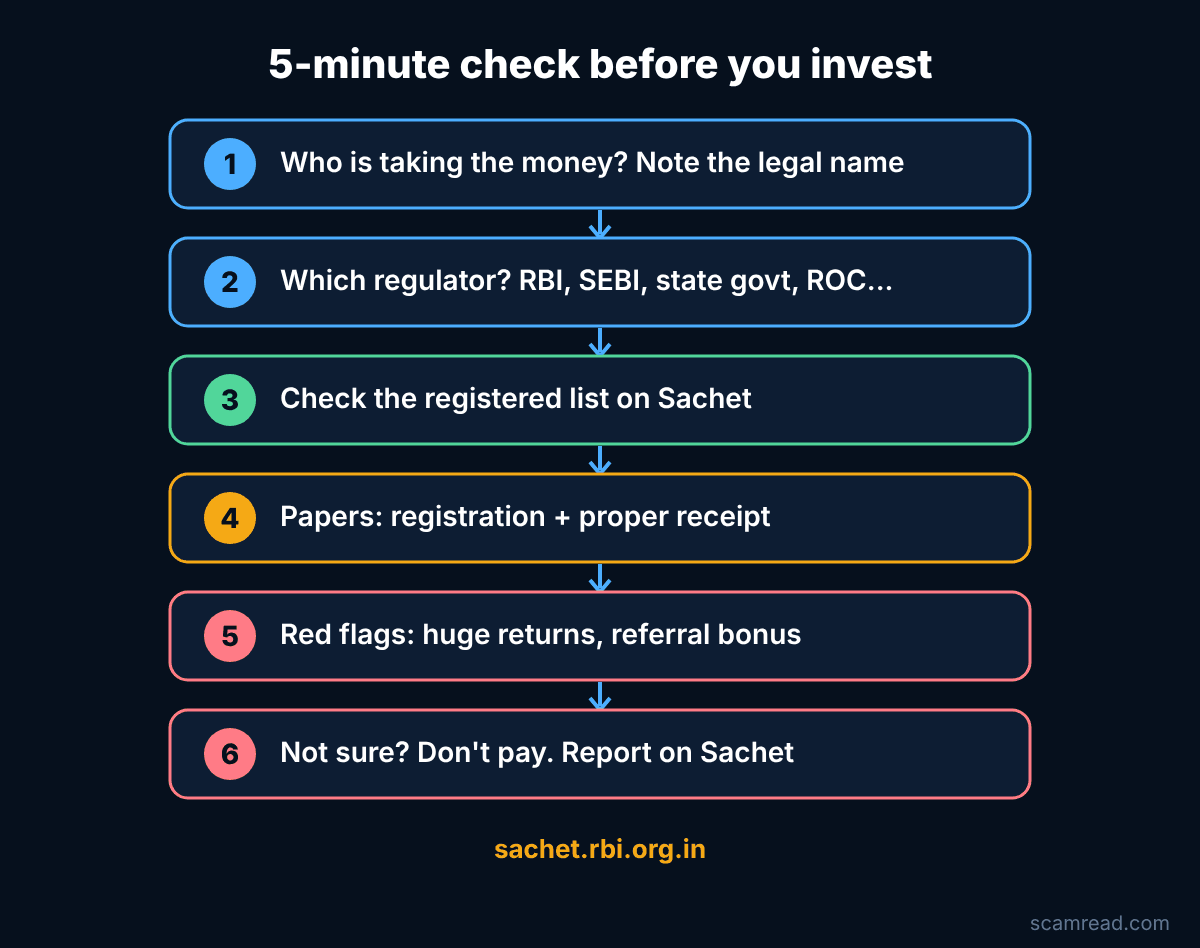
- Who is taking the money? Write down the exact legal name – not just the brand or the agent’s name.
- Which regulator? Use the table below to find who should regulate this kind of scheme.
- Check the list. On Sachet, open “Registered Entities” for the lists of entities registered with different regulators. For NBFC deposits, RBI says to check both its list of deposit-taking NBFCs and its list of NBFCs not allowed to take deposits.
- Check the papers. An NBFC’s Certificate of Registration should say it may accept deposits. Insist on a proper receipt for every payment.
- Check the agent. Confirm with the company itself that the agent collecting money works for them.
A real name on a list doesn’t prove the person messaging you works there – scammers borrow real names. See how to check if a company is registered in India and how to reverse image search a profile picture.
Who regulates what
Quick guide (from RBI’s NBFC FAQ)
- NBFC deposits – RBI
- Collective investment schemes – SEBI
- Chit funds – State governments, under the Chit Funds Act, 1982
- Multi-level marketing / direct selling – not RBI; state governments and consumer law
- Money circulation schemes – banned under the Prize Chits and Money Circulation Schemes (Banning) Act, 1978
- Companies – Registrar of Companies (Ministry of Corporate Affairs)
Red flags RBI warns about
- Unusually high returns. RBI says the chance of losing money is higher in schemes that offer high rates.
- Returns that depend on bringing in new members or new money.
- No proper receipt, or money paid to a personal UPI ID.
- An individual, a proprietorship or a partnership firm collecting public deposits.
- Jewellery-shop “instalment” schemes that promise to return your money with interest – RBI says these can count as deposits.
Also good to know: RBI’s FAQ says NBFC deposits are for 12 to 60 months, the interest rate cap is currently 12.5%, and NBFC deposits are not covered by deposit insurance.
Example (fake)
Join Golden Growth Club! Deposit ₹50,000 and get ₹5,000 every month guaranteed. RBI approved. Refer 3 friends for bonus. Pay today to goldengrowth@okaxis
₹5,000 a month on ₹50,000 is 10% a month – far above anything a regulated deposit pays. The referral bonus and “RBI approved” claim are more red flags.
How to report a scheme
On sachet.rbi.org.in, use “File a Complaint” and keep the reference number. Use “Track your complaint” to follow it. The site says a new version is coming, so menu names may change.
For banned chit, pyramid or Ponzi schemes, RBI’s FAQ also points to the state police or the state’s Economic Offences Wing (EOW).
What to do
- Don’t pay until you have done the 5-minute check.
- Never invest because a group, relative or “RBI approved” image says so.
- Report the scheme on Sachet, even if you didn’t invest.
- Already paid? Call 1930 or report on cybercrime.gov.in, and go to your local police or EOW with receipts and chats.
Report it
Lost money or spotted a fraud? Call 1930 (National Cyber Crime Helpline) or report at cybercrime.gov.in. Report quickly – the sooner you report, the better the chance of stopping the money.
Related: What happens after a cyber crime complaint
Not sure about a message?
Before you pay into any scheme shared on WhatsApp or Telegram, run the message through the free ScamRead checker – then check the entity on Sachet yourself. Open the checker →