The phone rings late in the evening. A young voice, shaky and upset: “Grandma? It’s me. I’m in trouble. Please don’t tell Mom.” Then a calm “lawyer” takes over and explains that bail is needed today, in cash, and that a courier can come to your house to pick it up.
This is the grandparent scam, also called the family emergency scam, and it is one of the oldest and most effective phone cons in America. In 2026 it sounds more convincing than ever, because scammers can now copy a loved one’s voice with AI.
The verdict: if a caller says your grandchild is in jail or in the hospital, demands cash, gift cards, crypto or a wire, and asks you to keep it secret, it is a scam. Hang up and call your grandchild on the number you already have.
On October 9, 2026, federal prosecutors in Vermont announced a prison sentence for a Canadian man who helped steal from about 20 elderly Americans using fake “bail bondsmen.” Here’s how the con works, how to spot it in seconds, and what to do if you’ve already paid.
Why this scam works so well
- Panic beats logic. Hearing that a grandchild is hurt or arrested switches off careful thinking.
- Secrecy cuts off help. “Don’t tell Mom” sounds like a real embarrassed kid. It also stops the one phone call that would expose the lie.
- Authority makes it feel official. A second caller plays a lawyer, police officer, public defender or bail bondsman, using legal-sounding talk about court dates and fees.
- The details are real. Names, schools and travel plans are easy to find on social media. The FTC warns scammers may also simply guess, and let you fill in the blanks.
- The voice can be fake. The FTC says a scammer can clone a voice from a short audio clip, often taken from videos posted online.
How the scam works, step by step
- The call. A “grandchild” calls, crying or speaking quietly. A bad connection, a “broken nose” or “a cold” explains why they sound a little off.
- The emergency. An arrest, a hospital stay, or a car accident. In one Kentucky ring, prosecutors said it was usually a car accident.
- The handoff. The “grandchild” passes the phone to a “lawyer,” “officer” or “bail bondsman” who explains how much money is needed and how fast.
- The secrecy order. You’re told not to tell anyone, often with a made-up legal reason.
- The payment. Cash handed to a courier at your door, cash mailed in a box through UPS or FedEx, gift card numbers, a wire, a payment app or a crypto ATM.
- The second hit. If you pay once, they call back with a new “complication” and a new fee, until someone in the family finds out.
Real cases: the couriers who came to the door
Vermont, October 2026. The U.S. Attorney’s Office for the District of Vermont announced on October 9, 2026 that Paul Conneh, 39, of Moncton, New Brunswick, was sentenced to 33 months in prison and ordered to pay $256,000 in restitution. According to court records, he recruited “bail bondsmen” to travel to the United States and collect money from elderly victims, then laundered the money and passed it to co-conspirators. Prosecutors said the scheme victimized about 20 elderly Americans during a three-week stretch in July and August 2023.
Kentucky, the ring that took over $3 million. In a separate case, the U.S. Attorney’s Office for the Western District of Kentucky sentenced the sixth and final defendant in a grandparent scam run from Canadian call centers. Callers invented a family emergency, “couriers” collected cash at victims’ homes, and others laundered it through banks and crypto exchanges. Prosecutors said hundreds of victims lost over $3 million.
Pennsylvania, cash in the mail. In another ring, callers posed as grandchildren or their attorneys, and victims shipped cash by UPS and FedEx. The man who coordinated the pickups got 80 months in prison.
The same courier playbook shows up in other scams too. We covered it in detail in our guide to the gold bar scam, where “agents” pick up gold instead of cash.
ScamRead Scam Checker
Got a message from a “lawyer” or “bail agent”?
Scammers often follow the call with a text, email or WhatsApp message with payment details or a link. Paste it into ScamRead and get a free, instant read on whether it’s a scam.
New variants to watch for in 2026
- AI voice clones. This is the AI voice scam everyone is worried about. The FBI warned in a December 2024 public service announcement that criminals use AI-generated audio to “impersonate a close relative in a crisis situation.” The FBI’s 2025 Internet Crime Report says victims reported over $5 million in losses to these AI-powered “distress” scams in 2025, and that they are expanding to imitate other family members and close friends, not just grandkids.
- Text and WhatsApp follow-ups. After the call, a “lawyer” may text payment instructions, a mailing address for cash, or a payment link.
- Doorstep couriers. In this bail money scam, a stranger posing as a bondsman or courier comes to your home to collect the cash.
- Fake ransom calls. The FBI warns cloned voices are also used in calls claiming a loved one is being held for ransom.
The scammer’s toolkit
| Tool | What it does | Why it works |
|---|---|---|
| Social media profiles | Gives names, schools, trips and relationships | The story includes details only “family” would know |
| AI voice cloning | Copies a voice from a short online clip | You hear someone you love, so you stop questioning |
| Fake lawyer or officer | Takes over the call and sets the price | Authority makes the demand feel official and urgent |
| Secrecy demands | Tells you not to call anyone | Blocks the one call that would end the scam |
| Couriers and mail drops | Collect cash at your door or by UPS/FedEx | Cash is fast, hard to trace, and nearly impossible to recall |
| Gift cards and crypto ATMs | Move money instantly | No bank fraud team stands between you and the scammer |
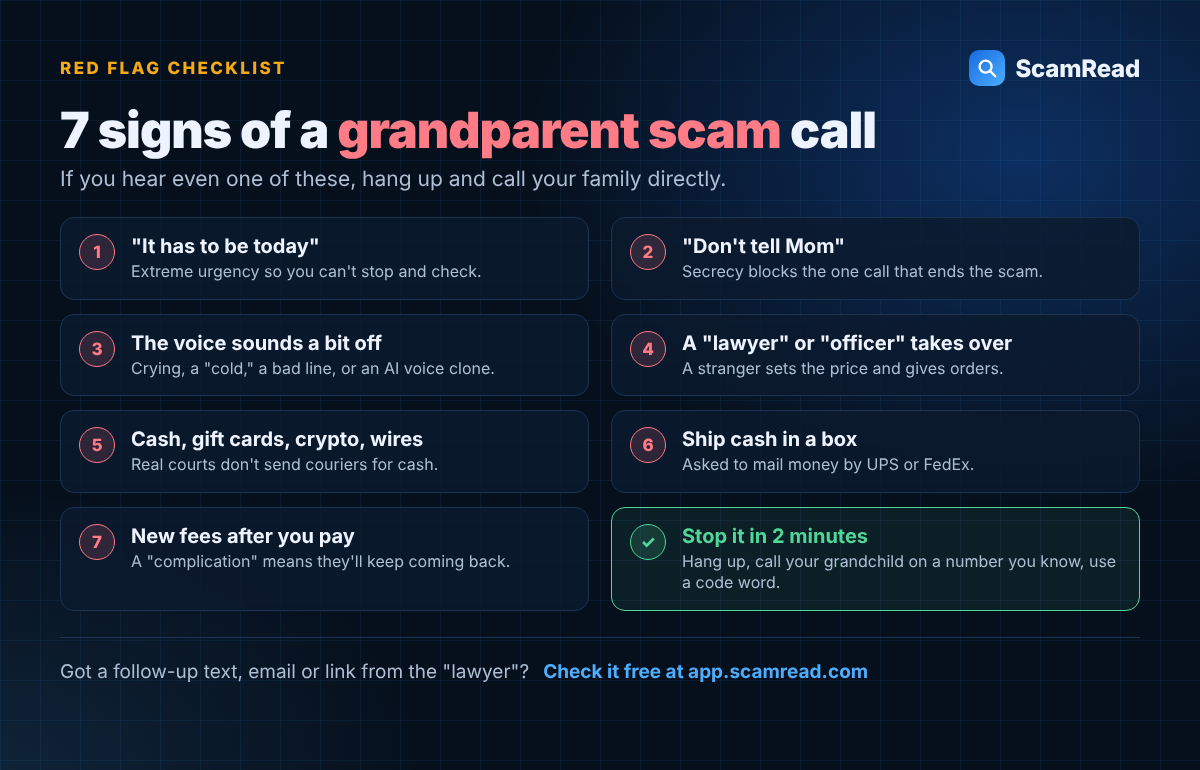
7 red flags of a grandparent scam call
- Urgency: the money is needed today, or “in the next hour.”
- Secrecy: “Don’t tell Mom,” or “the judge says you can’t discuss it.”
- The voice sounds a little off, with an excuse (crying, a cold, a broken nose, a bad line).
- A stranger takes over as lawyer, officer or bondsman.
- Cash, gift cards, crypto or wires. Courts and bail offices don’t send couriers to collect cash at your house.
- Money by mail: you’re asked to pack cash in a box and ship it by UPS or FedEx.
- The story changes or new fees appear after you’ve paid once.
How to check if the call is real
- Hang up. You are allowed to. A real emergency will still be real in five minutes.
- Call your grandchild directly on the number you already have, not one the caller gives you.
- Call their parents or another relative, even though you were told not to.
- Ask a question only they would know, like the name of the family pet.
- Use a family code word. The FBI recommends creating “a secret word or phrase” with your family. Set one up this week.
- Look up the jail yourself. Find its official number and ask if the person is really there.
- Check any follow-up message. If a “lawyer” texts payment instructions, emails a “bail form,” or sends a WhatsApp message or link, paste it into the free ScamRead checker before you do anything.
ScamRead Scam Checker
Pause before you pay
Before you send cash, buy gift cards or click a payment link, paste the text, email or link you received into ScamRead. It takes seconds and it’s free.
Already paid or shared info? Do this now
- Call your bank or payment company immediately (use the number on your card) and ask them to stop or reverse the payment. The sooner, the better.
- Gift cards: call the card company, report the scam, and keep the cards and receipts.
- Cash mailed by UPS or FedEx: call the shipper right away with the tracking number and ask to intercept the package. If a courier is due to come back for more, call local police.
- If you shared your Social Security number or bank details, freeze your credit at Equifax, Experian and TransUnion, and follow the recovery plan at IdentityTheft.gov.
- Report it to the FBI at ic3.gov and the FTC at ReportFraud.ftc.gov. If you’re 60 or older, the National Elder Fraud Hotline is 833-FRAUD-11 (833-372-8311).
- Beware the follow-up. Victims are often contacted again by people promising to “recover” the money for a fee. That’s a recovery scam.
Don’t blame yourself. These are professional criminals running scripts all day.
How these scammers get caught
- The money trail. Cash has to be picked up by a real person at a real address. In the Kentucky case, couriers and a money launderer were sentenced along with the managers.
- International cooperation. In the Vermont case, the defendant was arrested in Costa Rica and extradited, with help from HSI, IRS Criminal Investigation and Interpol.
- Your report. Reports to ic3.gov and the FTC connect cases across states. One report can link a courier to a whole ring.
Grandparent scam FAQ
What is the grandparent scam?
It’s a phone scam where someone pretends to be your grandchild, or their lawyer or a police officer, and says they urgently need money for bail, a hospital bill or an accident. A grandparent scam call is designed to get you to pay before you check the story.
Can scammers really copy my grandchild’s voice?
Yes. The FTC and FBI both warn that scammers use AI to clone voices from short clips, often from videos posted online. Don’t trust a voice alone. Hang up and call back on a number you know.
How do I protect my parents or grandparents from this scam?
Set up a family code word, tell them about this scam by name, and agree that it’s always OK to call another relative, “secret” or not.
I got a text from a “lawyer” after the call. Is it real?
Almost certainly not, if it asks for money, secrecy or a payment link. You can paste the message into the ScamRead scam checker for a free analysis, then call your family directly.
The bottom line
The grandparent scam is built to make you act before you think. Beat it with one habit: hang up and call your family yourself. No real emergency is made worse by a two-minute check.
Share this with the grandparents in your life. And if a scary text, email, WhatsApp message or link shows up after a call like this, check it with ScamRead before you reply.
Sources
- U.S. Attorney’s Office, District of Vermont: Canadian man sentenced to prison for participation in “grandparent scam” (Oct. 9, 2026)
- U.S. Attorney’s Office, Western District of Kentucky: Sixth and final defendant sentenced in grandparent scam (June 2025)
- U.S. Attorney’s Office, Middle District of Pennsylvania: Bronx man sentenced for role as lead courier in “grandparents” mail fraud scheme (March 2024)
- FTC: Scammers Use Fake Emergencies To Steal Your Money
- FBI IC3: Criminals Use Generative Artificial Intelligence to Facilitate Financial Fraud (Dec. 2024)
- FBI IC3: 2025 Internet Crime Report