Your phone rings. The caller says he is a deputy with the county sheriff’s office. You missed jury duty, a judge has signed a warrant for your arrest, and officers are on their way, unless you pay a fine right now.
This is a scam. No court, sheriff or police department in the United States calls to collect a fine for missed jury duty, and none will cancel an arrest over the phone.
The jury duty scam call is the most common version of a fast-growing crime: criminals impersonating law enforcement. Between January 2025 and July 2026, the FBI received nearly 61,000 complaints about it, with reported losses of more than $1.6 billion (FBI IC3). Federal courts in Pennsylvania, Maryland, Texas and Connecticut have all posted warnings.
This guide covers how the call works step by step, the newer text, email and fake-website versions, how to check if a call is real, and exactly what to do if you already paid.
ScamRead Scam Checker
Got a text or email about missed jury duty?
Paste it into ScamRead before you reply, click or pay. It checks the message for the warning signs used in jury duty and fake warrant scams, in seconds.
Why would a sheriff call me about jury duty?
A real sheriff almost never would. In the United States, jury service is handled by the court clerk, and jury summonses arrive by mail. If you truly miss jury duty, the usual result is a letter or a notice to appear before a judge, not a phone call demanding money.
That is exactly why scammers chose this story. Most people do not remember every letter they received, so “you missed jury duty” sounds believable. And almost everyone is afraid of being arrested.
How the jury duty scam call works
The script is almost the same across the country:
- The scare. A “deputy,” “sergeant” or “U.S. Marshal” says you missed jury duty or a court date, and that a warrant has been issued.
- The proof. The caller ID shows a real sheriff’s office number. The caller uses the name of a real officer and a real local judge, gives a badge number, and may send a “warrant” with an official seal.
- The isolation. You are told to stay on the line, tell no one, and not explain to your bank why you are withdrawing cash.
- The fix. The warrant can be cleared if you pay a “bond” today, often several thousand dollars, in cash, gift cards, a payment app or at a Bitcoin ATM.
- The second hit. Once you pay, a new fee appears: a “processing fee” or a second bond.
Real case: Arizona, 2026. A retired nurse got a call on her 70th birthday from someone using the name of a real Maricopa County chief deputy. He said she had missed jury duty and faced arrest for contempt of court. He named a real judge, gave a badge number, and sent an official-looking barcode for payment. She deposited $9,260 into a Bitcoin kiosk at a convenience store. Then the caller demanded $12,000 more (Fox News).
Real case: Connecticut, 2026. A woman in Southington was told by a fake Hartford police officer that she had a federal arrest warrant. He kept her on the phone and sent her to a gas station in another state to buy Bitcoin. She lost $14,000, and police said recovery was unlikely because the scammers were probably overseas (WFSB).
The new versions: texts, emails and fake court websites
The phone call is no longer the only version. Watch for:
- Texts and emails with a “warrant” attached, listing the amount you owe for missing jury duty. Real law enforcement does not text or email arrest warrants (FTC).
- Fake court websites. The caller sends you to an official-looking site with government seals, where you enter your birthdate and Social Security number to “look up how much you owe.” Fines of up to $10,000 are demanded (FTC). A fake court site is almost always brand new. Learn how to check if a website is a scam by looking up its age.
- “Government kiosks.” You are told to pay at a special government kiosk. These do not exist. It is a Bitcoin ATM.
- AI video calls. The FBI warns that some scammers now use AI to appear as uniformed officials on video (FBI IC3).
Got one of these texts or emails? Paste it into the ScamRead scam checker to see the red flags before you do anything else.
The scammer’s toolkit
| Tool | What it does | Why it works |
|---|---|---|
| Caller ID spoofing | Shows a real sheriff’s office number | People trust the number on screen |
| Public records and leaked data | Gives them your name, address and relatives | Personal details sound official |
| Real names | Real officers’ and judges’ names from public websites | A quick Google search seems to confirm the story |
| Fake warrants and websites | Seals, case numbers, barcodes | A document feels like proof |
| Bitcoin ATMs and gift cards | Money that cannot be reversed | Once sent, it is almost never recovered |
5 things a real officer or court will never do
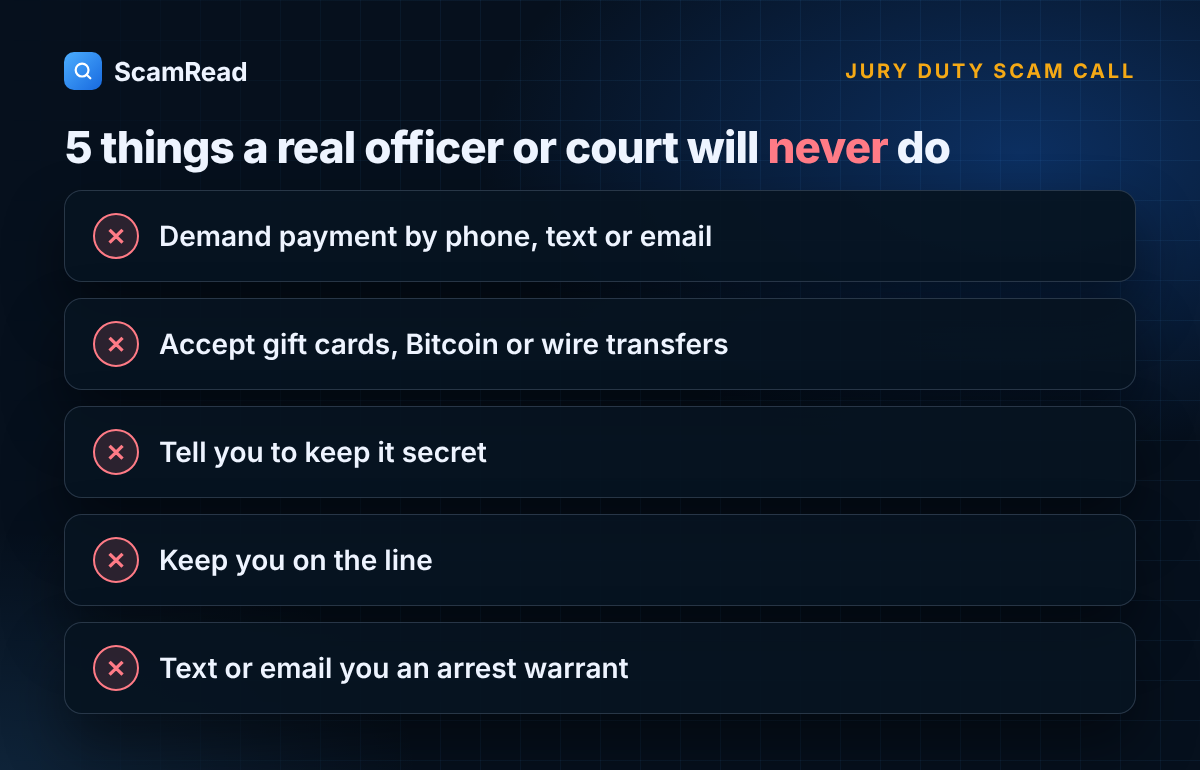
- Demand payment by phone, text or email to cancel a warrant or a jury duty penalty.
- Accept gift cards, Bitcoin, payment apps or wire transfers. Only scammers ask for these.
- Tell you to keep it secret from your family, lawyer or bank.
- Keep you on the line or stop you from calling back.
- Text or email you an arrest warrant.
If a caller does even one of these, you are not talking to law enforcement.
Got a jury duty scam call? How to check if it’s real
- Hang up. Do not call back the number that called you. It may be spoofed.
- Find your county court clerk yourself, on the court’s official .gov website.
- Call the clerk and ask whether you missed jury service or have any warrant. This takes minutes and costs nothing.
- Tell someone you trust. The scam only works while you are alone and afraid.
- Got a follow-up text, email or link? Run it through ScamRead. Scammers often send a fake “warrant” or payment link after the call.
Already paid or shared information? Do this now
If you already paid after a jury duty scam call, act today. Speed is the only thing that improves your chances.
- Stop all contact and block the number.
- Call your bank or the payment company. A wire or card payment can sometimes be stopped. For gift cards, call the number on the back of the card, ask them to freeze the balance, and keep the cards and receipts. For a Bitcoin ATM, call the kiosk company using the number on the machine or receipt. Some states, such as Arizona, now have laws that help kiosk fraud victims get money back.
- Protect your identity if you gave your Social Security number or bank details. Freeze your credit with Equifax, Experian and TransUnion, and follow the plan at IdentityTheft.gov.
- Report it at ic3.gov, at ReportFraud.ftc.gov, and to your local sheriff on the non-emergency line.
Beware of “recovery” calls. Victims are often contacted later by people claiming they can recover the money for a fee, sometimes posing as FBI staff. The FBI has warned that criminals even build fake copies of its complaint website (Infosecurity Magazine). Always type ic3.gov into your browser yourself.
ScamRead Scam Checker
Protect the people you love
Older relatives are the main target of these calls. Bookmark ScamRead on their phone so they can check any suspicious message before they act.
How these scammers get caught
These cases are hard, but the money trail is their weak point. Banks, crypto exchanges and Bitcoin ATM operators must verify their customers, so investigators follow where the money lands. The people who collect the money, often recruited as “mules,” lead to those above them. Many gangs operate overseas, which makes arrests slow and recovery rare.
That is why your report matters. Investigators link complaints that share a phone number, a wallet address or a script. Keep every detail: the number that called, times, receipts, wallet addresses and screenshots.
Frequently asked questions
What should I do if I get a jury duty scam call?
Hang up without paying or sharing anything. Look up your county court clerk on the court’s official website and call to check. Then report the call at ReportFraud.ftc.gov.
Is the missed jury duty call a scam?
Yes. Courts send jury notices by mail and never demand payment by phone, gift card or Bitcoin to avoid arrest.
Will a sheriff call you about a warrant?
A sheriff’s office may contact you about a case, but it will never ask you to pay over the phone to cancel a warrant. Warrants are resolved through a court.
Why does the caller ID show the real sheriff’s number?
Scammers use caller ID spoofing to show any number they want. A real number on screen does not prove a real caller.
What happens if I really missed jury duty?
You will usually receive a letter from the court, sometimes with a new date or a notice to appear. Call your court clerk to sort it out. You will not be asked to pay by phone.
I paid. Can I get my money back?
Sometimes, if you act fast. Call your bank or the payment company immediately, then report it at ic3.gov and ReportFraud.ftc.gov.
Not sure about a call, text or email?
Paste the message into the free ScamRead scam checker before you pay or click anything. It works with texts, emails, WhatsApp messages and links. And share this guide with an older relative. They are the people these callers target most.
Related: That Job Offer Came With a Cheque: Here’s Why You Should Never Deposit It
Sources
- FBI IC3: Law enforcement impersonation scams, September 17, 2026
- FTC: Ignore calls, texts and emails threatening to arrest you for missing jury duty, June 2026
- FTC: Scammers are using fake websites in a twist on jury duty scams, August 2025
- Fox News: Jury duty scam tricks nurse into depositing $9,260 at Bitcoin kiosk
- WFSB: Southington woman loses $14,000 in Bitcoin scam involving fake police officer
- Infosecurity Magazine: FBI says threat actors are spoofing its IC3 site